
Why Weathered Driveways Add Decades to Your Property’s Appearance
When you pull into your neighborhood, your eyes likely dance across the familiar sights: the neighbor’s new rose bushes, the freshly painted trim on the corner house, or perhaps the modern mailbox someone recently installed. But there is a silent, sprawling giant that occupies nearly 30% to 50% of your home’s front-facing visual real estate—and it is likely the primary reason your house looks ten years older than it actually is. We are talking about the driveway. It is the “welcome mat” of the modern American home, the literal path that leads to your sanctuary. Yet, because we use it every single day, we often become “house blind” to its slow, steady degradation.
For homeowners in Maryland, maintaining this curb appeal can be a constant struggle against the humid climate and heavy seasonal shifts. Utilizing professional Towson power washing services is often the most effective way to strip away years of built-up grime and restore the driveway’s original luster without the massive expense of a full replacement. By addressing these surface issues early, residents can ensure their property retains its youthful, vibrant appearance despite the local weather’s best efforts. While we obsess over interior kitchen trends or the color of the front door, the driveway is out there, battling the elements and industrial fluids, slowly shifting the perception of your home from “well-maintained” to “tired.”
The Visual Weight of the Driveway
To understand why a driveway has such a massive impact on age perception, we have to look at how the human brain processes “curb appeal.” When we look at a property, our brains perform what psychologists call “thin-slicing”—making a complex judgment based on a very narrow window of experience. Because the driveway is a large, flat, continuous plane, it acts as the visual foundation for the house.
If that foundation looks weathered, the brain subconsciously applies that “weathered” label to the entire structure. Even if your siding is brand new and your windows are crystal clear, a stained, pitted driveway creates a “halo effect” of neglect. Think of your home as a piece of art: the landscaping is the matting, and the driveway is the bottom edge of the frame. If the frame is scratched, faded, and covered in grime, the artwork inside feels less valuable. A pristine driveway provides a sharp, high-contrast border that makes the colors of your home and lawn “pop.”
The Three Arch-Nemesis of Driveway Longevity
Driveways don’t just look old because of time; they look old because they are under constant chemical and physical assault. Unlike your walls, which are protected by eaves and paint, the driveway is a porous horizontal surface that catches everything the world throws at it.
1. UV Degradation: The “Graying” Effect
Both asphalt and concrete are victims of the sun.
- Asphalt: When it is first laid, asphalt is a rich, deep obsidian black. This is due to the bitumen (the tar-like binder). Over time, UV rays break down the molecular bonds of the bitumen, a process called oxidation. The rich black fades to a ghostly, chalky gray.
- Concrete: While concrete is naturally light, UV exposure and weather cause the surface paste to wear away, exposing the “salt and pepper” aggregate underneath. This creates a mottled, uneven texture that looks significantly more aged than a smooth, creamy finish.
2. Traffic Residue and Chemical Staining
Every time a car pulls onto your property, it brings a cocktail of industrial pollutants. Tire scrub—micro-particles of rubber left behind as tires turn—combines with carbon and soot from exhaust to settle deep into the pores of the material. However, the most aggressive agers are automotive fluids. Because concrete and asphalt are porous, oil, coolant, and brake fluid are “wicked” down into the material, creating deep, dark shadows that suggest mechanical failure and a lack of general home maintenance.
3. Biological Growth (The “Ruins” Look)
Nothing says “ancient” like greenery growing where it shouldn’t. When dirt settles into small fissures, it creates a perfect nursery for moss, algae, and weeds.
- Algae (Gloeocapsa magma): Those black streaks you see aren’t just dirt; they are often a hardy species of cyanobacteria. They feed on the minerals in the concrete, making the surface look perpetually damp or dirty.
- Root Expansion: As weeds grow, their roots act like tiny wedges, expanding cracks further. This creates a visual pattern of “fracturing” that our brains associate with ruins and structural decay.
The Science of Weathering: The Freeze-Thaw Cycle
The climate dictates how quickly your driveway will betray your home’s true age. The most damaging phenomenon is the Freeze-Thaw Cycle. When water enters the pores or micro-cracks of a driveway and freezes, it expands by approximately 9%. This expansion exerts incredible internal pressure on the material. When it thaws, it leaves behind a slightly larger void. Over a single winter, this can happen dozens of times, leading to:
- Spalling: Where the top layer of the surface literally flakes off.
- Potholes: Where the sub-base becomes compromised.
- Alligator Cracking: A series of interconnected cracks that look like the skin of a reptile—a tell-tale sign of an aged surface.
Driveway Condition Comparison
| Feature | New/Well-Maintained | Aged/Weathered |
| Color | Deep Black (Asphalt) / Creamy White (Concrete) | Faded Gray / Mottled Yellow |
| Texture | Smooth, uniform, and tight | Pitted, “Salt and Pepper” aggregate exposed |
| Edge Quality | Sharp, defined borders against the lawn | Crumbled edges, overgrown with grass/weeds |
| Surface | Clean, reflective of natural light | Dull, absorbent of stains and organic growth |
Why “Clean” Equals “New” in the Human Mind
Have you ever noticed how a brand-new housing development looks so pristine? It’s not just the modern architecture; it’s the uniformity of the surfaces. New asphalt is perfectly black; new concrete is perfectly uniform. When a homeowner invests in driveway restoration, it creates a “visual reset.” It tricks the eye into believing the entire property is newer than it is.
This is why real estate agents almost always recommend “freshening up” the driveway before a listing. It is one of the highest returns on investment (ROI) because it changes the “first-impression” narrative from “this house needs work” to “this house is move-in ready.” A clean driveway suggests that the owner pays attention to the details, leading buyers to assume the hidden parts of the house (HVAC, plumbing, electrical) are also well-maintained.
Restoration: The Power of a Professional Refresh
The good news is that you don’t always need to tear up your driveway to shed ten years off your home’s appearance. Many driveways are structurally sound but “aesthetically bankrupt.”
The Magic of High-Pressure Water
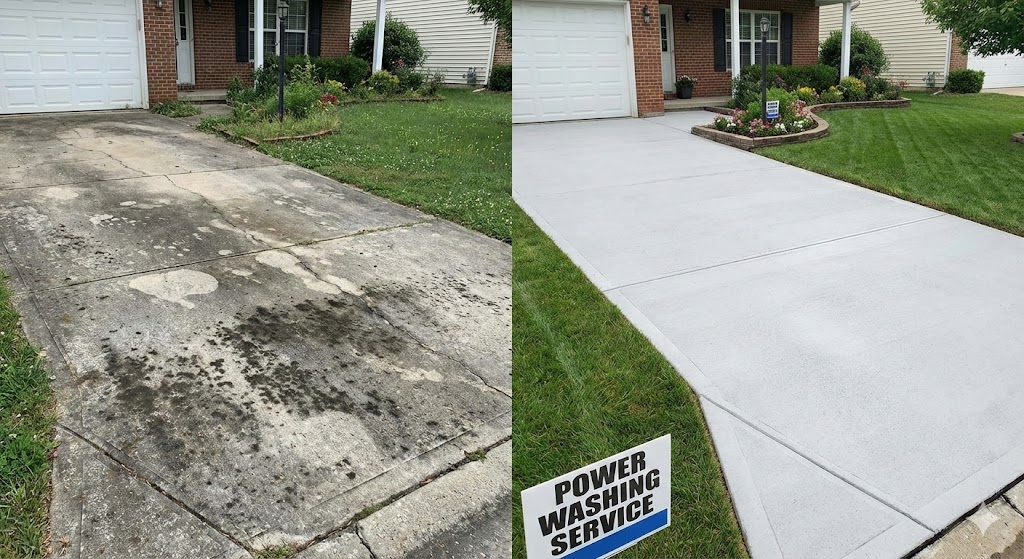
Power washing is the single most cost-effective way to de-age a home. A professional-grade service uses high-pressure water combined with specialized, biodegradable detergents to lift years of carbon, algae, and oil out of the pores.
- The Result: Concrete that was once dark gray or black returns to its original bright, sandy-white hue.
- The Impact: This brightness reflects more light toward the house, making the front of the property appear brighter and more inviting, even on cloudy days.
Sealcoating and Crack Filling
For asphalt, sealcoating is the equivalent of a “facelift.” It applies a new layer of bitumen and polymers over the top, instantly restoring that deep black color and filling in minor surface imperfections. For concrete, a high-quality penetrating sealer can prevent future staining and stop the freeze-thaw cycle from causing further spalling.
Pro Tip: If your driveway has “spiderweb” cracks but is still level, a resurfacing compound can be applied. This is a thin layer of specialized concrete that bonds to the old surface, giving you the look of a brand-new pour at a fraction of the cost of a full demolition.
Conclusion
Your driveway is more than just a place to park your car; it is the stage upon which your home sits. When that stage is stained, cracked, and faded, it acts as a visual weight that pulls down the aesthetic value of everything around it. By understanding the factors that cause driveway aging—UV rays, traffic residue, and biological growth—you can take proactive steps to maintain its youthful appearance.
Whether it’s a weekend spent cleaning or hiring a professional team to handle the heavy lifting, tending to your driveway is the fastest way to ensure your home looks as young and vibrant as it feels on the inside. Don’t let your “welcome mat” tell a story of neglect when your home has so much more to offer.